


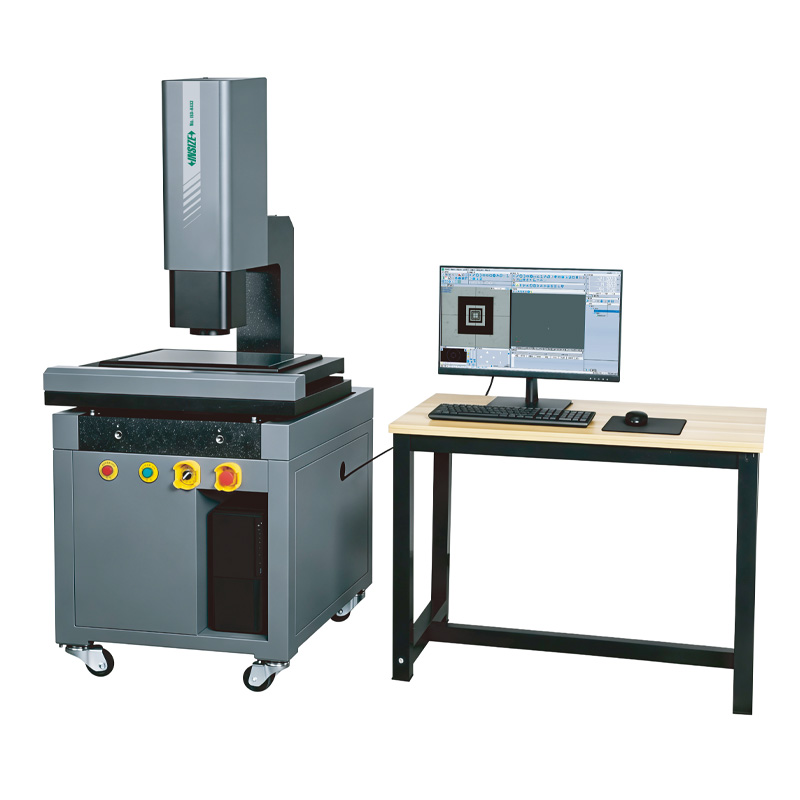
CNC Vision Measuring Systems (Advanced Type)
Code: ISD-K Series
Motorized zoom objective
Granite body, high accuracy and stability
Panasonic servo control motor, with precise positioning performance in high-speed movement
RSF brand linear scales
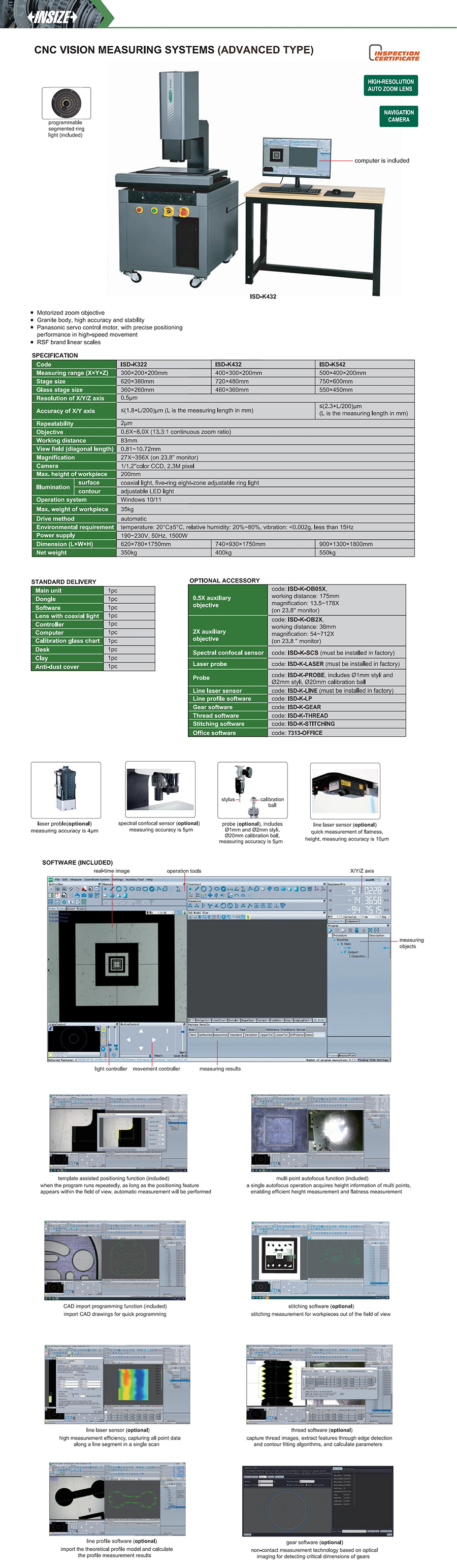
| Code | Range | Accuracy | Resolution | Repeatability | Magnification | Max. load |
|---|---|---|---|---|---|---|
| ISD-K322 | 300×200×200mm | ≤(1.8+L/200)µm | 0.5µm | 2µm | 27X~356X (on 23.8'' monitor) | 35kg |
| ISD-K432 | 400×300×200mm | ≤(1.8+L/200)µm | 0.5µm | 2µm | 27X~356X (on 23.8'' monitor) | 35kg |
| ISD-K542 | 500×400×200mm | ≤(2.3+L/200)µm | 0.5µm | 2µm | 27X~356X (on 23.8'' monitor) | 35kg |


View the complete
product specifications
FAQ
What accuracy can the ISD-K achieve, and how does it compare to the ISD-R?
The ISD-K322 and ISD-K432 are rated at ≤(1.8+L/200)µm for X/Y accuracy (with a customizable option down to (1.4+L/200)µm), compared to ≤(2.5+L/200)µm on the equivalent ISD-R models. The ISD-K also offers a wider continuous zoom range (0.6X–8.0X vs. 0.7x–5.0x on the ISD-R).
What optional modules are available for the ISD-K, and when would I need them?
The ISD-K supports optional gear software, thread software, line laser sensor, stitching software, a contact probe, and a laser probe. These optional modules are generally applied for the inspection of special workpieces or 3D features. The gear measurement software is used to detect gear tooth dimensions, the thread measurement software for acquiring thread parameters, and the probe system enables measurement of various 3D features including cylinders, cones, spheres and planes.
Does the ISD-K support both optical and contact-probe measurement in the same setup?
Yes. With the optional Renishaw contact probe installed, the ISD-K can combine optical imaging with physical probe contact in a single workflow, overcoming the limitations of purely optical measurement in inspecting complex workpiece features — such as certain 3D Features or hard-to-illuminate surfaces.
What are the differences among ISD-K, ISD-R and ISD-V?
ISD-K and ISD-R adopt identical structural design, software system and optional functions. Their main distinction lies in internal core component configuration: ISD-K is fitted with components from top international brands, such as linear scales from RSF and Panasonic servo motors, whereas ISD-R utilizes more cost-effective components. The ISD-V features a benchtop structure, unlike the floor-standing ISD-K and ISD-R. It has a more compact footprint and can meet basic measurement requirements, yet there is a gap in software functions compared to ISD-K and ISD-R.